Stop repeating failures your company already understands.
You ship the same product again: a new generation, a new variant, a new customer
programme. Truke KF makes the failure modes found on the last one arrive on the
next one by themselves — not because somebody remembered to look.
✓ Self-hosted — your failure history never leaves your infrastructure ✓ Free for teams up to 5 ✓ No registration to evaluate
• A Base FMEA is only as good as the last person who copied it
The AIAG/VDA handbook is explicit about this: step 1 of a new FMEA is to start from
the Base FMEA for the product family, so the analysis begins with everything already
known rather than from scratch.
In practice the Base FMEA is a file. It gets copied into the new programme, and from
that moment it stops knowing anything. When a warranty return three months later
proves that a cause everyone rated occurrence 2 happens rather often, that
lesson lands in one engineer's copy. The other eleven programmes that inherited the
same optimistic rating never hear about it, because nothing connects them —
they are copies, not instances.
Why an Excel FMEA doesn't learn →
This is not a documentation problem. Most suppliers document diligently, because
their customers require it. It is a reuse problem, and it costs the same money
twice.
• Is this you?
KF earns its place in some engineering organisations and not others. The difference
is not the industry — it is whether you build the same kind of thing more than
once.
Built for you if
You have 10–200 engineers
You ship variants and generations of the same product, not unrelated one-offs
You already run FMEA — AIAG/VDA, SAE J1739 or IEC 60812
Your customers audit you: IATF 16949, ISO 9001, ASPICE
What you know is spread across Excel, SharePoint or Confluence, Jira, and a few people's memories
A field failure costs you real money, and a repeated one costs you the account
Probably not, if
Every project genuinely starts from nothing — there is nothing to inherit into
You need a full AIAG/VDA suite: process control plans, DVP&R integration, boundary and parameter diagrams. KF does not do these, and says so
You want a service somebody else operates. KF is self-hosted by design; that is the point, not a limitation we are working around
Your analyses are small and isolated, and a spreadsheet already fits
• What changes
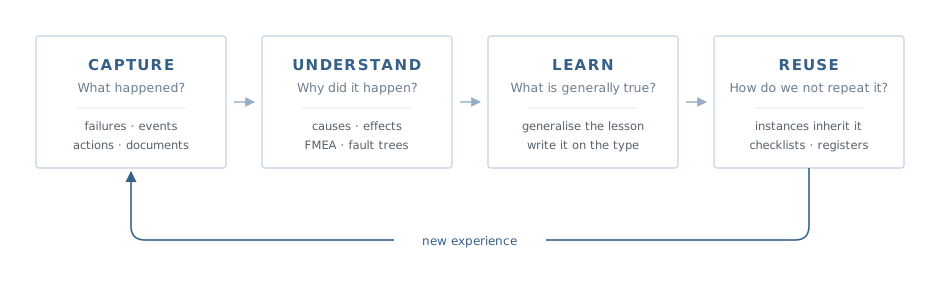
A reference design carries what the family has learned. A variant is an
instance of it, and inherits that automatically — including lessons
written after the variant already existed. Nothing is copied; the picture is derived
every time it is read.
How Experience Inheritance works →
• The standards you already work to
HARA, AIAG/VDA, J1739 and IEC 60812 are the same activity in different words, so KF
implements one model and configures it per standard. Action Priority and ASIL ship as
presets, not as bespoke code.
Each page carries a clause-by-clause mapping, and the AIAG/VDA one ends in a
compliance table with the gaps marked as gaps. There is a row in it that reads
process control plan — not supported. If a table like that is useful to
you rather than alarming, we are probably a good fit.
• Built, then attacked
Two of these were run as tests rather than demonstrations: acceptance criteria written
down before the work started, and what failed recorded next to what worked. Each one
produced a database you can open.
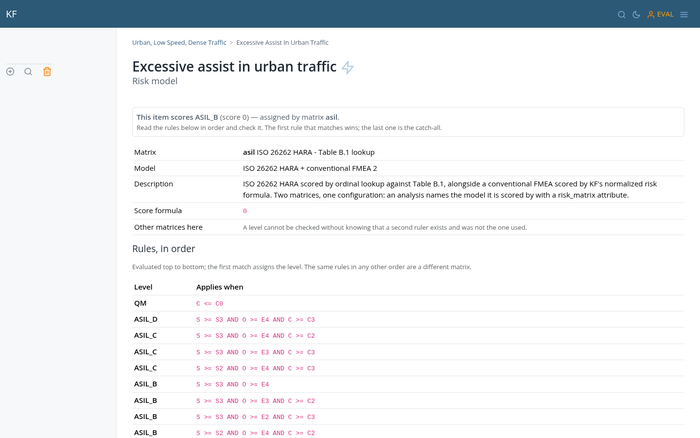
An electric power steering HARA: item definition, malfunctions, operational
situations, hazardous events classified S/E/C, ASIL determined, safety goals derived.
Ten of ten reference S/E/C→ASIL vectors reproduced with no code changes —
and a HARA and a conventional component FMEA in one database, each with its own
matrix.
An 8D cycle as a reusable type, with one question put to it: when a team learns
something on Monday, does it reach the programmes that started last year?
Yes, and retroactively — a preventive action promoted to a type appeared as an
open checklist row on an instance typed before the lesson existed, with nothing
written to that instance.
We are not asking you to replace anything. Requirements stay wherever they live,
meeting notes stay in the wiki, tickets stay in Jira, and the BOM stays in the system
that owns it. KF takes the knowledge that currently falls between those tools —
failure modes, causes, corrective actions, the obligations a programme has taken on
— and keeps it connected to the products it belongs to.
A component tree imports from CSV or XLSX and round-trips back out with a provenance
header. Everything KF stores is reachable over a
documented REST API, and an
MCP endpoint lets an AI assistant answer from your
failure history rather than from the internet.
KF alongside a wiki →
Your company already paid for its mistakes.
Evaluate KF on real work, with no registration and no time limit. If the failure
history you would put in it is the reason you are hesitating, note that it never
leaves your own infrastructure.